· Destination Weddings · 6 min read
Getting Married in Italy: The Australian Catch
A legal Italian wedding can count in Australia, but name changes and replacement certificates are harder. Here's the simpler Australian option.
Dreaming of getting married in Italy?
Yes. Obviously. Italy is almost unfairly good at being Italy.
Tuscany at golden hour. A table full of people you love. Lake Como doing Lake Como things. Sicily being dramatic in the best possible way. The Amalfi Coast looking like it was designed by someone who charges by the adjective.
Then someone asks the sensible question.
“But how do we actually get legally married there?”
And suddenly the romance is sitting next to a folder called paperwork.
Here is the truth: Australians can legally marry in Italy. It is not fake. It is not pretend. If your Italian marriage is valid under Italian law, and it would also be valid under Australian law, Australia will generally recognise it. Smartraveller says as much in its overseas marriage advice.
But possible and simple are not the same word.
And the real catch is often not the wedding day.
It is the admin afterwards.
You can be legally married, but you may not get the same easy Australian surname-change pathway. You can have a valid marriage certificate, but if you need another copy in ten years, you are probably dealing with the Italian municipality that registered it. If your bank, passport office, licence authority, Medicare, or super fund wants the paperwork presented a certain way, the romance of a foreign certificate can get very practical very quickly.
That is the hook for me.
Not “Italy is impossible.”
Just “why make the rest of your Australian life admin harder than it needs to be?”
What Australians need to legally marry in Italy
The official guidance for Australian citizens points to two main documents: the Atto Notorio and the Nulla Osta. The Australian Embassy in Rome has a guide to marriage in Italy, and the Italian Consulate in Brisbane also outlines the process for Australians.
In plain English, you may be dealing with:
- an Atto Notorio, which is a formal declaration that there is no legal impediment to your marriage
- a Nulla Osta, usually signed in Italy before an Australian consular officer
- your passports
- original birth certificates
- evidence of divorce or death of a former spouse, if relevant
- translations into Italian
- apostilles or legalisation of documents
- appointments with the Embassy, Consulate, Prefettura, and local Comune
- an interpreter if required
That list can change depending on your citizenship, personal circumstances, where in Italy you are marrying, and what the local Comune asks for. The Comune is the local town hall or municipality, and in Italy the local office matters.
This is general information, not legal advice. If you want the Italian civil marriage to be the legal marriage, check the current requirements with the relevant Italian Comune, the Italian Consulate, and the Australian Embassy or Consulate in Italy before you build a wedding around it.
The annoying bit nobody tells you
None of this means Italy is doing anything wrong.
Every country has its own rules. Australia has paperwork too. I am a marriage celebrant, not a magician with a printer.
But when you are planning a destination wedding, the Italian legal path can become its own side quest. You are already booking travel, choosing a location, wrangling guests, finding accommodation, planning food, wondering if Nonna can handle the cobblestones, and praying no airline decides to express itself creatively that week.
Adding government appointments in another language is not always the romantic flourish couples had in mind.
And then there is the life-admin bit afterwards.
If you marry overseas, you cannot register that marriage in Australia. Australia may recognise the marriage, but your official certificate is the overseas one. Smartraveller notes that a foreign marriage certificate is usually proof of the marriage, but may not work neatly as proof for a name change in Australia. NSW Births, Deaths and Marriages says an overseas marriage certificate cannot be used to change your surname after marriage in NSW. Victoria says if you married overseas, you need to apply to change your name.
Some organisations are fine. Some want more. Some will ask for translations or extra documents because apparently love needs a help desk ticket.
Again, not impossible.
Just more.
The option I recommend to most Australian couples
Do the legal marriage in Australia before you fly.
Then have the wedding you actually want in Italy.
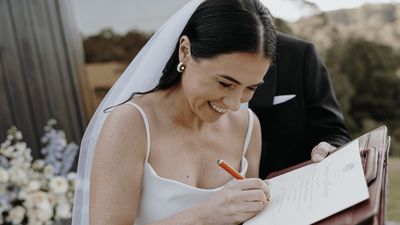
That means we complete the Notice of Intended Marriage, do the legal Australian ceremony with your two witnesses, sign the certificates, and I lodge the paperwork with Births, Deaths and Marriages here.
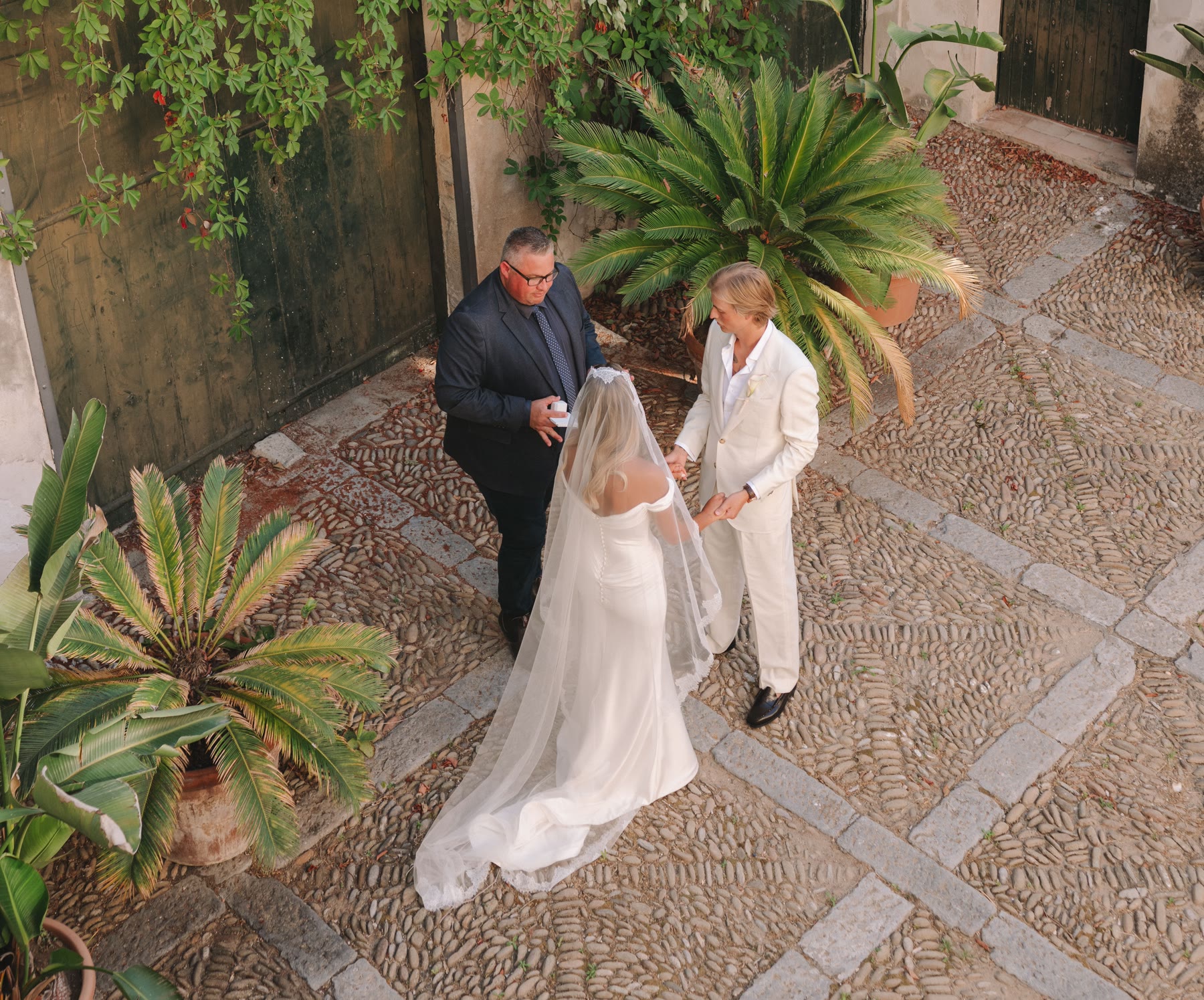
Then, when we get to Italy, your ceremony can be completely focused on the thing everyone came for: you two making brave, honest promises to each other in a place that feels alive.
No Comune appointment in the middle of the week.
No wondering if a document has the right stamp.
No losing half a day to paperwork when you could be eating cacio e pepe in a linen shirt.
Just the ceremony, the vows, the people, the setting, the photos, the party, and the deep exhale of knowing the marriage is already legally solid.
Does that make the Italian ceremony less real?
Not even slightly.
The legal paperwork creates a marriage in the eyes of the state.
The ceremony creates the moment in the eyes of your people.
Those are both important, but they do not have to happen in the same place, on the same day, under the same bureaucracy.
Most guests do not know which sentence made the marriage legal. They remember how it felt. They remember the look on your faces. They remember the vows. They remember the laughter. They remember the way the room, garden, villa, cliff, courtyard, or tiny lane in Italy seemed to hold its breath for a second.
That is the wedding.
The legal ceremony in Australia is not the discount version. It is the clean admin layer that lets the Italy ceremony breathe.
Why I like this path
You get an Australian marriage certificate.
Your name-change admin is usually simpler because Australian organisations understand Australian documents. In many cases, changing your surname after an Australian marriage does not require the same formal change-of-name application. You use the official Australian marriage certificate as the evidence.
If you need another certificate later, you order it from the Australian registry instead of chasing a municipality overseas.
Your Italian wedding day stays free from paperwork energy.
And if you are booking me as your celebrant in Europe, this is the cleanest way I can serve you: I look after your Australian legals before we leave, then I stand with you in Italy and create the ceremony you actually wanted.
Because I can lead your ceremony in Italy, but I cannot turn Italian soil into Australia just by putting on a nice jacket. The Australian legal marriage needs to happen in Australia. The Italian ceremony can be the full-hearted, no-scripts, no-fluff, best-part-of-the-day wedding.
Which, honestly, is the bit everyone will remember anyway.
Planning an Italy wedding or elopement?
If you are dreaming of Tuscany, Lake Como, Sicily, Rome, Puglia, the Amalfi Coast, or somewhere else in Europe where the light looks like it has a publicist, start with my European destination wedding celebrant page.
If you want the full elopement team around you, including planning and photography, have a look at The Elopement Collective in Europe.
Italy can absolutely be where you get married.
I just think Australia should probably be where the paperwork lives.
Photo by Jason Corroto.